
Protecting Brand Equity: The Shift from Blanket Discounts to Dynamic Promotions
Site-wide discounts train customers to wait for the next sale. AI-driven dynamic promotions, filtered by retail wisdom, protect margins and premium positioning.
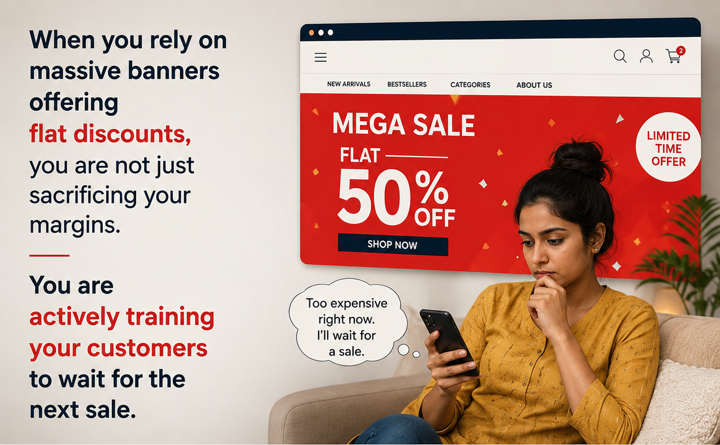
Walk into any digital storefront during a holiday weekend, and you will likely see the exact same strategy. A massive, unavoidable banner sits at the top of the homepage, proudly offering twenty or thirty percent off the entire site.
This approach certainly generates a temporary spike in revenue. However, for D2C and FMCG brands, this outdated strategy is quietly destroying long term profitability. When you rely on generic, site wide discounts, you are not just sacrificing your margins. You are actively training your consumers to wait for the next sale.
In a highly competitive digital marketplace, preserving your brand equity requires a fundamental shift in promotional strategy. The modern solution lies in moving away from the blunt instrument of blanket discounting and embracing the surgical precision of AI driven dynamic promotions. By filtering advanced predictive analytics through decades of retail margin management, brands can protect their premium positioning while successfully converting high intent buyers.
The Commercial Danger of the Site Wide Sale
The traditional promotional playbook is built on a flawed premise. It assumes that all website visitors require the exact same financial incentive to complete a purchase. In reality, offering a flat discount to every visitor is incredibly inefficient.
When a brand repeatedly utilizes site wide sales, several negative commercial outcomes occur:
- Conditioned Consumer Behavior: Shoppers are highly intelligent. If they see a brand offer a major discount every holiday or end of season, they will simply abandon their carts and wait for the next inevitable promotion.
- Unnecessary Margin Erosion: A significant portion of your daily website traffic consists of consumers who are already prepared to pay full price. When you display a site wide discount banner, you are giving away margin to customers who did not need an incentive to convert.
- Brand Devaluation: Premium positioning relies on perceived value. Constant discounting signals to the market that the core product is simply not worth its stated retail price.
To break this cycle, brands must transition to tactical promotions. The goal is to offer the right incentive, to the right specific customer, at the exact moment of highest purchasing friction.
The AI Utility: Predictive Analytics and Real Time Intent
Achieving this level of precision used to be impossible for growing brands. Today, predictive analytics and artificial intelligence have completely transformed promotional architecture.
Modern AI utilities operate quietly in the background of your e commerce platform. Instead of a generic banner, these tools analyze thousands of real time data points to predict consumer intent. The technology evaluates how long a user lingers on a specific product page, their previous purchase history, their scrolling speed, and even real time competitor pricing across the internet.
When the AI detects a high level of purchasing friction, such as a user repeatedly visiting a checkout page without completing the transaction, it deploys a surgical, personalized offer.
The advantages of this AI integration include:
- Dynamic Price Fencing: AI can ensure that targeted offers are only visible to specific users based on their browsing behavior, keeping the public facing retail price completely intact.
- Competitor Agility: Machine learning models can monitor competitor pricing in real time. If a direct competitor launches a flash sale, your AI can automatically deploy targeted retention offers to your most vulnerable customer segments without triggering a public price war.
- Optimized Incentive Scaling: The AI determines the minimum viable discount required to convert a specific user. One user might need a ten percent discount, while another might convert with a simple offer for expedited shipping.
Real World Example 1: The Premium Nutritional Supplement
Consider a high end direct to consumer nutritional brand. For years, their primary growth lever was a massive site wide sale every November. While revenue spiked, their customer acquisition costs were rising, and their overall profit margins were shrinking.
They decided to integrate an AI driven predictive promotional engine. Instead of a public sale, the website maintained its premium, full price appearance. Behind the scenes, the AI tracked user behavior.
When a new visitor showed high intent by adding items to their cart but hesitated on the shipping page, the AI intervened. Rather than offering a standard cash discount, the system deployed a personalized pop up. It offered a complimentary travel sized product if the user completed their purchase within fifteen minutes.
The results were transformative. By utilizing a product based incentive rather than a cash discount, the brand protected its perceived monetary value. Furthermore, they completely avoided giving margin away to the loyal subscribers who were already checking out at full price. Their conversion rate increased, and their overall margin profile improved significantly.
The Wisdom Filter: Margin Management and Premium Narratives
While AI provides the data and the delivery mechanism, the technology alone is not enough. Algorithms are exceptional at identifying hesitation, but they do not inherently understand prestige, brand voice, or long term margin strategy. This is where the executive Wisdom Filter becomes critical.
Decades of traditional retail and FMCG margin management teach us a vital lesson. A discount must never look like an act of desperation. It must be carefully wrapped in a premium narrative.
Human brand guardians must program the AI with strict strategic parameters:
- Controlling the Vocabulary: Instead of allowing the system to use aggressive terms like "discount" or "clearance," seasoned marketers frame the offers as "exclusive trials," "VIP upgrades," or "founder's circle benefits."
- Protecting Unit Economics: Executive oversight is required to set the absolute floor for pricing. The AI must be restricted from offering combinations of incentives that would result in a negative gross margin on the first order.
- Balancing Incentives: Human wisdom dictates whether a specific customer segment responds better to a percentage discount, a fixed dollar amount off, or an upgraded shipping tier.
Real World Example 2: The Specialty Skincare Launch
A luxury skincare brand faced a difficult scenario. Shortly after launching a new premium serum, a major competitor aggressively dropped their prices on a highly similar product.
The algorithmic AI recommendation was to immediately match the competitor pricing to prevent customer churn. However, the executive team applied their Wisdom Filter. They knew that engaging in a public price war would permanently damage their luxury positioning and erode their brand equity.
Instead of a public price drop, they used the AI to identify their most loyal repeat purchasers and those who had recently viewed the competitor's website. The brand then deployed a highly targeted email campaign exclusively to this group — framed not as a discount, but as an exclusive benefit for their most valued customers.
By combining precise AI targeting with a premium narrative filter, the brand retained its at risk segment without ever compromising its public price integrity or signaling weakness to the broader market.