
Beyond Demographics: How AI Sentiment Analysis Unlocks True D2C Consumer Drivers
Demographics tell you who is buying. AI sentiment analysis, filtered through market wisdom, tells you why — and reframes the job your brand is actually being hired to do.
Meet your target customer. She is 32 years old, lives in a major metropolitan area, earns a comfortable household income, and occasionally shops for organic products.
Ten years ago, this demographic profile was the gold standard for brand marketing. Today, in the hyper competitive Direct to Consumer space, relying on these basic metrics is a fast track to irrelevance. Demographics tell you who is buying your product, but they completely fail to tell you why they are buying it.
Consumers do not make purchasing decisions because of their age or their zip code. They buy products to solve specific problems, alleviate hidden frustrations, or achieve a desired emotional state. To win in today's market, modern brands must move beyond surface level data and tap into the core motivations of their audience. This requires a shift from simple demographic targeting to advanced AI sentiment analysis, filtered through the lens of real world market wisdom.
Here is a deep dive into how generative AI is transforming consumer research, and how human expertise turns that raw data into powerful brand growth.
The Illusion of Knowing Your Customer
The traditional D2C playbook relies heavily on surveys, focus groups, and platform analytics. While these tools provide structured data, they suffer from a massive blind spot: human bias. When you ask a consumer why they bought a luxury face serum in a survey, they will likely give you a rational, logical answer about ingredients or pricing.
However, consumer behavior is rarely strictly logical. The real truth lives in the unfiltered, spontaneous conversations happening across the internet. It lives in the late night Reddit threads, the long form YouTube reviews, and the buried comments on Instagram ads.
Historically, mining this unstructured data was impossible at scale. A marketing team could read a few hundred reviews, but they could not synthesize tens of thousands of data points across multiple platforms to find statistically significant emotional triggers. This is where the landscape has fundamentally changed.
The AI Utility: Listening at a Global Scale
Generative AI and advanced natural language processing tools are no longer just for writing emails or generating images. They are the most powerful listening engines ever created.
Instead of relying on a sample size of 50 people in a focus group, AI allows a brand to ingest 50,000 user reviews, social media comments, and forum discussions simultaneously. The AI does not just tally keywords. It understands context, sarcasm, and emotional tone. It can identify the underlying friction points that consumers are experiencing with your category, long before those issues show up in a quarterly sales report.
This technology categorizes raw text into distinct emotional clusters. It highlights what makes your customers feel anxious, what makes them feel confident, and what specific micro moments trigger a purchase.
Real World Example 1: The Skincare Routine Rebellion
Consider a premium D2C skincare brand that had plateaued in customer acquisition. Their traditional demographic profile targeted women between 25 and 40 who were interested in wellness and anti aging. Their ad copy reflected this, focusing on "youthful glow" and complex, multi step skincare routines.
By deploying AI sentiment analysis across competitor reviews and social media platforms, a completely different narrative emerged. The AI processed thousands of comments and flagged a massive spike in words associated with "exhaustion," "overwhelm," and "decision fatigue."
The data revealed a hidden behavioral shift. The target audience was not looking for a 10 step wellness ritual. They were busy, stressed professionals who felt burdened by the expectations of modern beauty standards.
The Wisdom Filter: Moving from Sentiment to "Jobs to be Done"
Data alone does not build a brand. If a business simply looked at the AI output of "exhaustion," they might have just launched a marketing campaign about being tired. This is where real world market wisdom and executive experience become critical.
The AI provides the raw intelligence. Human strategy translates that intelligence into the "Jobs to be Done" framework.
The Jobs to be Done theory suggests that consumers do not buy products; they "hire" them to do a specific job in their lives. In the case of the skincare brand, the executive filter interpreted the AI data to build a new consumer profile.
- The Demographic Assumption: The customer wants to look younger.
- The AI Insight: The customer feels overwhelmed by complex routines.
- The Job to be Done: "I need a single, highly effective product that gives me a sense of control and self care in under two minutes before I collapse into bed."
By understanding this deep seated motivation, the brand completely repositioned its flagship product. They stopped selling a "youthful glow" and started selling "high performance simplicity." Ad copy shifted to address the friction point directly, resulting in a dramatic drop in customer acquisition costs.
Real World Example 2: The Functional Beverage Pivot
Another powerful application of this methodology occurred with a D2C functional beverage brand selling mushroom infused coffee.
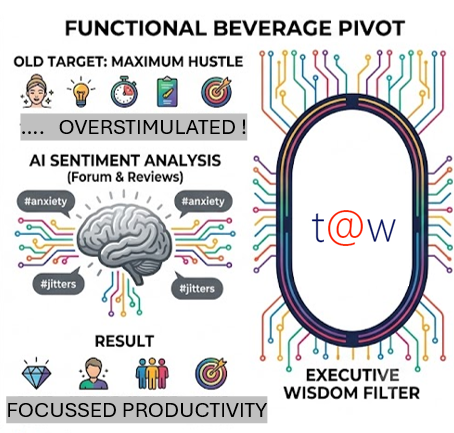
Their initial marketing strategy targeted the classic "hustle culture" demographic: tech workers, entrepreneurs, and fitness enthusiasts looking for maximum energy and productivity. The visuals were bold, and the messaging was aggressive. Sales were steady, but retention was poor.
The brand utilized AI to scrape niche health forums, podcast transcripts, and thousands of Amazon reviews across the entire energy drink category. The sentiment analysis uncovered a surprising trend. The most passionate conversations were not about achieving maximum energy. The dominant emotional themes were "anxiety reduction," "avoiding the afternoon crash," and "mental clarity without jitters."
Applying the wisdom filter completely reframed their market approach.
- The Demographic Assumption: The customer needs more fuel for a 12 hour workday.
- The AI Insight: The customer is already overstimulated and fears the physical side effects of traditional caffeine.
- The Job to be Done: "Help me achieve a state of calm, focused productivity so I can complete my work without triggering an anxiety response."
The brand pivoted their entire communication strategy. They softened their visual identity and changed their messaging to focus on "clean focus" and "nervous system support." By speaking directly to the hidden struggle identified by AI, they unlocked a massive new segment of customers who had previously ignored traditional energy drinks.
Operationalizing the Insights for Growth
Transforming AI intelligence into practical business growth requires clear, tactical execution. Once you have built your deep dive Jobs to be Done profiles, they should dictate every aspect of your D2C operations:
- Tailored Creative Messaging: Ad copy must stop listing product features and start speaking directly to the customer's internal struggle. You are no longer selling a mattress; you are selling the job of "waking up without lower back pain so I can play with my kids."
- Product Development: New product launches should be designed specifically to fulfill unmet jobs identified by the AI sentiment scan, rather than just copying competitor trends.
- Retention Strategies: Post purchase email flows should validate the customer's decision based on their emotional drivers, ensuring they feel understood by the brand long after the initial transaction.
The Future of Brand Strategy
We are operating in an era where technology has commoditized basic market research. Any brand can access demographic data and surface level trends. The competitive advantage no longer lies in gathering data; it lies in interpreting it.
The future of D2C growth belongs to brands that successfully merge these two worlds. It requires the raw processing power of global AI technology to scan the digital horizon, combined tightly with decades of core retail wisdom to filter out the noise. When you stop looking at your customers as data points on a spreadsheet and start understanding the profound jobs they are hiring your brand to do, true scalable growth follows.